|
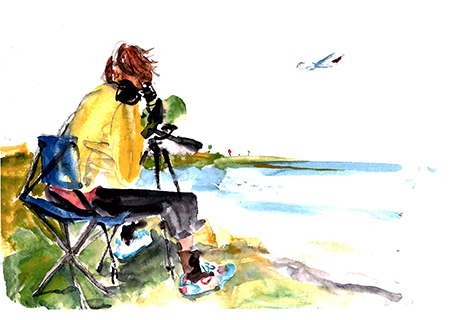
Watercolor by Laurie Wigham of CWL.
|
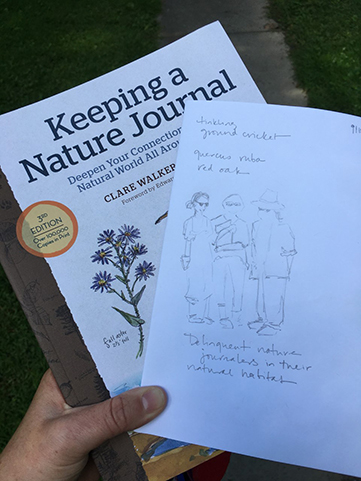
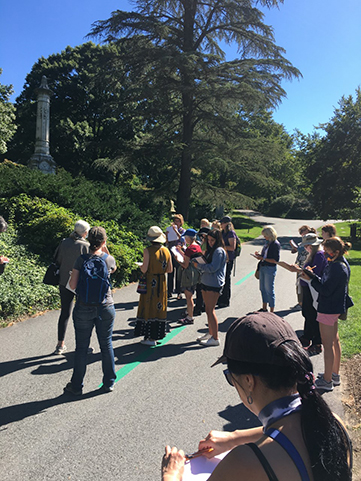
Book Launch for Keeping A Nature Journal,
Mount Auburn Cemetery
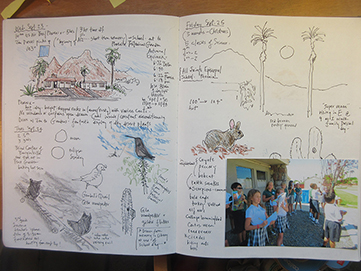
Nature Journal Club Workshop,
San Francisco, California
Connect With Nature for those Drawn to Nature:
Create Your Own Nature Journal
Clare offers classes and workshops across the country. The length of her programs range from workshops that are several hours in length to classes held over a series of weeks. Clare's programs include:
- Keeping a Nature Journal for students and/or teachers in grades k-12, in college biology or environmental studies programs, in adult education programs and in nature centers.
- Nature Study Drawing Courses designed for high school students and/or teachers, college students and art school students.
- Field Sketching for nature centers, college students and conferences.
Keeping a Nature Journal
The following outline describes a workshop designed for k-12 students and their teachers. I adapt this format for other settings and groups.
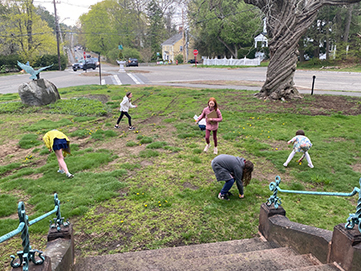
This workshop introduces teachers and students to creating nature journals, with an emphasis on using drawing as a tool for observation. We integrate science, writing, math and drawing with the goal of helping students to observe and connect with the natural world immediately around them. The intention is for participants to continue to use nature journals as part of their regular curricula and daily lives as learners.
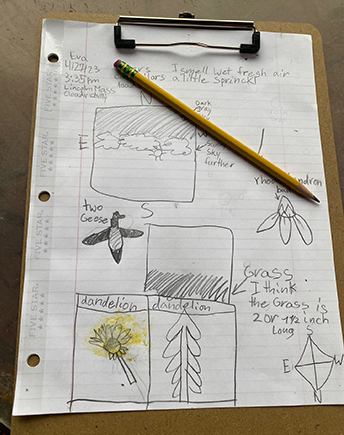
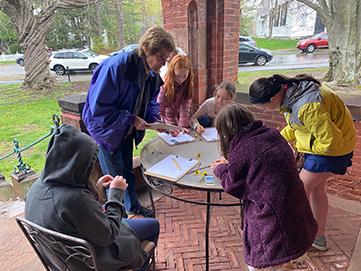
Generally, I teach within the structure of a typical 50- 60 minute classroom period. I start with a five minute introduction to the workshop, and the rest of the time is spent outdoors. During the introduction, I explain my own work and ask students to define a "naturalist." I explain that keeping a nature journal is not new, and that many naturalists/artists went on scientific expeditions to keep accurate records before the advent of modern technology. Many scientists today still add drawings to their observations and research. Next, with paper, clipboard, and pencils, the class and I begin the written part of the journaling documentation -- date, place, time, temperature, weather -- and discuss why keeping these records is important for their particular class. I ask the students what they think they'll find outdoors given the time of year and the location -- rather like a treasure hunt. With a list on the blackboard, the group heads outdoors.
I always investigate and draw with the students, explaining what things are and encouraging them to think critically by asking questions such as "Why do you think so many weeds grow here?" or "Why does this tree not look healthy?" or "Why does everyone think that posion ivy looks like so many other plants?"
I encourage teachers to keep a journal with the rest of the class, as their involvement helps the students feel better about what they are doing and helps the teacher see how she/he could integrate the experience into another classroom unit. The emphasis is not on drawing but on observation.
Students draw a number of images such as leaves, clouds, spiders and insects and label them so that they can remember what they have drawn. With three or four pages filled, students return to the classroom for a wrap-up of what they saw and how they can continue their journaling with their teacher without my assistance.
The nature journaling program has been very well-received in urban, suburban and rural schools. Through the use of hands-on exercises, it brings the study of the environment down to the immediate. A journal format provides immediate results for a wide range of learning abilities, and is something that classroom teachers can continue to use throughout the year, helping students follow the seasons in their own schoolyards.
"Truth is, missing out on Clare’s workshop meant missing out on meeting a very special and talented individual. From her special 'modified contour' drawing technique to her stories of European cranes, Clare (is) indeed a unique and interesting person. But, don’t despair, a bit of Clare is in each and every one of her books..."
-- Beth Reitz, Nebraska Environment Education Newsletter Editor
Since 1974, Clare has taught courses at:
John Muir Law's Nature Journal Club
San Francisco, CA / johnmuirlaws.com
Philips Exeter, Exeter, NH
All Saints Episcopal Elementary School, Phoenix, AZ
Galena Athabaskan Community School, Galena, Alaska
Peabody Essex Museum, Salem, MA
Shakerag Workshops, Sewanee, TN
Chittenden County Supervisory Union, Hinesburg, VT
Rowe Conference Center, Rowe, MA
Harvard Museum of Natural History, Cambridge, MA
Campbell Resource Center/ Science Specialists, Dorchester, Ma.
Mary Baldwin College, Staunton, VA
Real School Gardens, Fort Worth, Texas
Jane Goodall Institute / Roots and Shoots Program
Plymouth Elementary School. Plymouth, NH
Applewild School, Fitchburg, MA
Mather Elementary School, Dorchester, MA
Goodwillie Environmental School, Ada, Michigan
Antioch New England
Middlebury College
Williams College
Boston Museum of Science
Harvard University
New England Audubon Societies
Mass. College of Art
Cambridge Center for Adult Education
National Wildlife Federation Summits
Santa Barbara Museum of Natural History
National Audubon Society
Upper Raritan Watershed Association
Wagner Free Institute of Science
Carleton College
College of the Atlantic
Massachusetts public schools including:
| Arlington |
Ipswich |
| Athol |
Lexington |
| Belmont |
Maynard |
| Boston |
Medford |
| Cambridge |
Needham |
| Carlisle |
Somerville |
| Chatham |
Sudbury |
| Concord |
Wakefield |
| Dover |
Wayland |
| Fitchburg |
West Newbury |
| Harvard |
Williamstown |
| Harwich |
Worcester |
Private Schools and Centers in 29 States
|